
George is confused and he doesn’t know who’s advice to take.
A few weeks ago he received a juicy commission cheque and his accountant suggested he stick it in super before June 30 to save some tax.
But…if he was happy to stomach some extra risk he should buy an investment property and negatively gear it.
Meanwhile his poor wife is sitting bolt-upright in bed worried about their mortgage. It’s due for refinancing and she’s begging him to wait and see what the repayments will be.
What should he do?
In an ideal world he should do both. Stick as much as possible into super to save some tax and then slap the rest on the mortgage.
But on this occasion I agree with his wife. Sacrifice the tax saving and wait.
This scenario is very common. Clients often ask if it’s best to put any surplus cash on the mortgage or invest it?
Here’s the process I took George and his wife through to better understand my thesis…
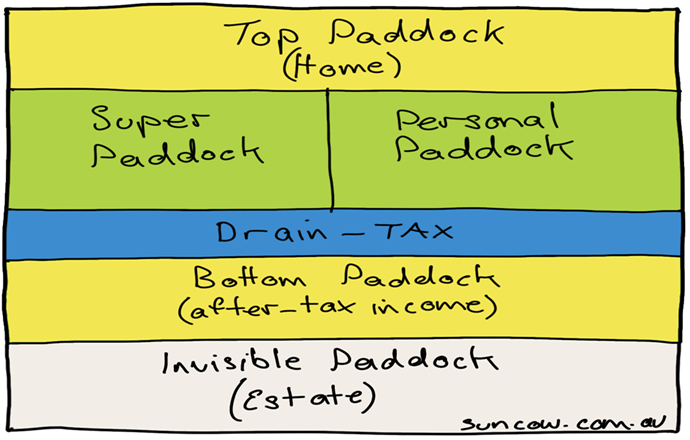
At Suncow, we split our clients finances up into five paddocks.
However, for the sake of this Moowsletter I’m going to focus on the top three paddocks only…
The top paddock is your principle place of residence. This paddock is tax free which is great when you sell your home however the loan is non-deductible.
Underneath the top paddock are your two wealth building paddocks – super and non-super (or personal).
Both these paddocks are taxable which means any income or capital gains are taxed. However any loans used to buy those assets are also deductible.
Therefore, the ultimate goal is to maximise the amount of money you get across the drain (tax) into your bottom paddock (after-tax dollars) for retirement.
Now back to George and his wife…
As a general rule, I recommend clients prioritise their paddocks in this order – top paddock, super paddock, and then personal paddock.
In other words, get your house paid off first because the debt is non-deductible.
For most people, not only is their mortgage their biggest expense but it’s their most expensive because they have to pay it off with after-tax dollars. i.e. no tax relief
Once the house is paid off, your next priority should be to jam as much money into super because the maximum tax rate is 15% and 0% in retirement.
Super is just a tax-effective paddock and it’s still the best game in town.
Finally, any surplus cash should be used to buy assets in your personal or non-super paddock.
The downside to building wealth in your personal paddock is it’s taxed at whatever your marginal rate of tax is. The upside is any debt is deductible.
Put simply, the best option for most people is to get rid of their non-deductible debt first – mortgage, personal loans, cards, etc.
The solution for George was simple.
Listen to your wife!
Have a great weekend!
Adam
Back paddock – collectively, the world spends 720 billion minutes a day using social media platforms. Over a full year, that adds up to 500 million years – GWI consumer trends report.
Still Going In — But Not Forever At some point, usually somewhere between 55 and 65, a thought surfaces that you can’t quite ignore. You’re not ready to stop completely. But you’re not sure you want to keep going at full pace either. The commute that felt fine at 45 feels heavier at 58. The …
Continue reading “Transition to Retirement: An Inner West Guide”
This question comes up constantly with clients in their 50s, and understandably so. The kids are largely through school. The income is better than it’s ever been. And for the first time in years, there’s actually surplus cash at the end of the month. The question is where to put it. The mortgage-vs-super debate gets …
Continue reading “Should You Pay Off Your Mortgage or Boost Your Super?”
The decade before retirement is the most financially consequential of your life. The decisions you make between 55 and 65 — or 50 and 60, depending on when you plan to stop working — have an outsized impact on what the next 30 years look like. Get them right and you arrive at retirement with …
Information provided by Suncow Wealth is general in nature and does not take into consideration your personal financial situation. It is for educational purposes only and does not constitute formal financial advice. Remember, the value of any investment can go down as well as up. Before acting, you should consider seeking independent personal financial advice that is tailored to your needs. Suncow Wealth Pty Ltd is a Corporate Representative No.441116 of AFSL 342766.