
Just after I left school, I went jackerooing on a seventy-thousand-acre sheep and cattle station out past Nyngan, about nine hours west of Sydney.
Our overseer was a fellow named Kevin, a man with military-like standards.
His clothes were always clean and pressed, his mop of brown hair perfectly parted, and his twenty-year-old ute never looked more than a month old.
But most importantly, he was a good guy.
One Saturday evening, I swung by Kevin’s place — literally in the middle of nowhere — to grab some instructions for a 4am muster.
I knocked on the door, stepped inside his immaculate little cottage, and saw a man who cut the loneliest figure I’ve ever seen.
Kevin, then in his mid-50s, sat at the kitchen table listening to the ABC radio, drinking long necks, completely alone.
It was his weekend routine.
No phone. No TV. Just a radio and a growing line of empty bottles.
For years I assumed his isolation was about location. But it wasn’t.
Like many others, Kevin had little idea how to mix and connect with people.
The thought of saying hello to a stranger — let alone starting a conversation with a potential partner — would have terrified him.
Yet I imagine he yearned for it.
Loneliness isn’t about being alone. It’s about lacking meaningful connection.
And now there’s talk of a ‘loneliness epidemic.’
But loneliness isn’t new — what’s new is we’re finally talking about it.
A recent Harvard study found loneliness has little to do with gender, race, education, or income.
For example, one in five Australians earning $100,000 a year report feeling lonely. More money doesn’t mean more connections.
And it’s not just an older person’s problem. Research shows young adults (18–24) are actually the loneliest group in Australia.
Social media creates the appearance of connection but it often leaves people comparing instead of connecting.
Incredibly, many young adults now avoid phone calls altogether, preferring to text for fear of saying the wrong thing!
What a paralyzing way to live.
At the same time, prescriptions for anti-depressants have exploded among people over seventy – many linked to loneliness.
For this cohort, loneliness is often triggered by life transitions.
For example:
The bloke who retires after forty years at the same company and suddenly realises his mates were really just workmates.
The woman whose husband dies and her social circle shrinks or shifts.
The kids moving out, leaving the house ghostly quiet.
The couple who do a sea change and discover that making friends at sixty is harder than they thought.
There’s no quick fix, but one of the best antidotes I know is service.
Service might not sound sexy because it implies work, but it’s one of the best ways to break the loneliness cycle.
Three reasons:
Mind shift – helping others gets you out of your own head. Circuit breaker.
Tribe – service connects you with like-minded people which builds community.
Action – doing something with someone is usually much easier (and often more fun) than trying to strike up a cold conversation. Think dating!
Imagine Kevin, same bloke, spending Fridays driving cancer patients from Nyngan to Dubbo Base Hospital.
Suddenly he’s got people who know his name, who wait for him in the driveway, who share their stories on the two-hour drive. He’s got purpose.
And imagine the stories he could share…
Like the time Elsey (the housemaid) found a brown snake at the bottom of a clothes basket!
The poor thing screamed that hard she lost her voice for two days.
Or the old catch-n-kill diet back on the station: lamb chops for breakfast, mutton sandwiches for lunch and lamb roast for dinner.
I kid you not.
And then when he’s done, maybe he grabs a coffee with another volunteer after drop-off.
The trick is to do service that feeds your soul because that builds the most meaningful connections.
For the past decade there’s been massive awareness about mental health, and rightly so.
But I reckon it’s time we started talking about our ‘social health’.
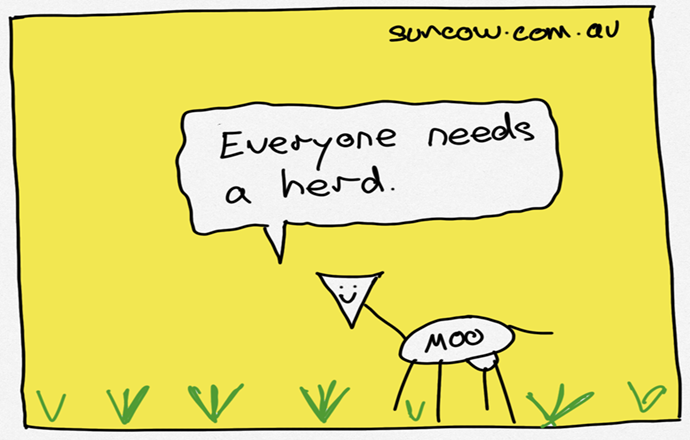
True happiness will never come from thousands of Facebook followers — it will come from the faces sitting at your table.
Have a great weekend!
Adam
It’s a Tuesday morning in March 2020. You check your super balance before breakfast. It’s down $80,000 from last week. You’re supposed to retire in four months. Your coffee goes cold on the bench. This is the scenario that terrifies every pre-retiree in Balmain. Not the abstract idea of a market crash – but the …
Continue reading “What Happens to Your Income When the Stock Market Crashes?”
You’re 52. You check your super balance: $380,000. Your stomach drops. “That’s all? After 30 years of working?” Then you remember that article you read: “You need $1 million to retire.” Quick math: You need to more than double your super in 13 years. That seems… impossible. So you do what many Australians in their …
Continue reading “Building Your Financial Herd: Investment Strategy in Your 50s”
Imagine you inherit a dairy farm with 50 healthy cows. Each cow produces milk that you can sell for income. Together, they generate enough money to live on comfortably. Now imagine someone suggests: “Why don’t you sell five cows this year to buy a new truck?” Sure, you’d get the truck. But now you only …
Continue reading “Why Your Investment ‘Cows’ Should Never Be Sold in Retirement”
Information provided by Suncow Wealth is general in nature and does not take into consideration your personal financial situation. It is for educational purposes only and does not constitute formal financial advice. Remember, the value of any investment can go down as well as up. Before acting, you should consider seeking independent personal financial advice that is tailored to your needs. Suncow Wealth Pty Ltd is a Corporate Representative No.441116 of AFSL 342766.