
Steve thinks I live in a cave…
“…I just read last week’s Moowsletter on your website…there’s no way interest rates are going up in the next three years…don’t you watch the news…get out of your cave!”
“Hi Steve, I’m tipping you’ve borrowed a lot of money?”
Steve must have been pretty fired up because he didn’t even have a dig at me about my ‘artwork’. Everyone else usually does!
Look, to be fair, Steve and the rest of his house bound mates may be right.
But there’s no way I’m telling clients everything’s sweet for the next three years just because the RBA or the (US) Fed said so.
Here’s why.
For the past twelve months every central bank around the world has printed and pumped squillions into their economies hoping to pull them out of a deep, dark hole.
And to an extent, it’s worked.
But everything has a tipping point and there’s now a growing concern they may have gone too far.
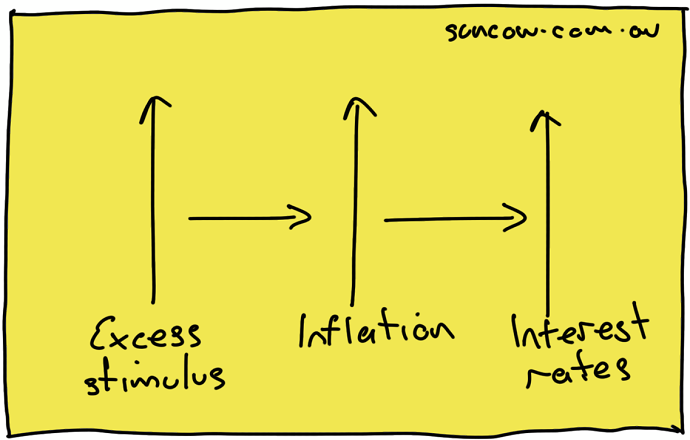
Put simply, the threat of inflation is gathering momentum and the only way to temper it is to either cut stimulus or hike interest rates.
So what do you do?
Do you sacrifice the poor and turn off the printing presses, or do you print more money at the risk of overheating the economy and force up interest rates?
Naturally, you’d keep printing and look after the poor.
But even if you continue with more stimulus, the poor may be no better off because their cost of living will simultaneously increase due to inflation.
Therefore, the net effect of more stimuli could be zero for those who need it most.
The problem is, concerns about an interest rate hike are also gathering momentum.
Enter the bond market…
Hang on Suncow! What’s a bond?
A bond is just a loan. And the only difference between a bond and a traditional loan is the lender of a bond is usually an investor. e.g. superfunds or private investors like you and I.
Make sense?
And this is where it gets interesting…
In the last five months, 10-year bond yields have gone from 0.5% to a recent high of 1.61%.
Meaning, investors (lenders) are now demanding higher interest rates from borrowers to compensate for inflation risk.
Or to put it another way, investors (lenders) expect the future cashflows of their repayments to diminish in value due to inflation, so they increase the interest repayments to compensate.
And eventually, central banks may be forced to do the same thing.
Meaning, they will eventually increase rates to protect consumers from a blow-out in living costs (inflation). Especially the poor.
The ‘lower for longer’ interest rate narrative may have worked during COVID, but the world is quickly moving on, and up.
Vaccines are re-opening economies with stacks of cash and pent-up demand.
And if 10-year bond yields are a forerunner for interest rates, you can expect a rate rise sooner than later.
The writing is on the cave wall.
Have a great weekend!
Adam
Back paddock – a mate of mine keeps a book of funny comments made by his son who has just turned five. On Thursday evening he phoned me with this gem…
“Hey Dad, I just worked out how to make a baby. You need a female and an email!”
Still Going In — But Not Forever At some point, usually somewhere between 55 and 65, a thought surfaces that you can’t quite ignore. You’re not ready to stop completely. But you’re not sure you want to keep going at full pace either. The commute that felt fine at 45 feels heavier at 58. The …
Continue reading “Transition to Retirement: An Inner West Guide”
This question comes up constantly with clients in their 50s, and understandably so. The kids are largely through school. The income is better than it’s ever been. And for the first time in years, there’s actually surplus cash at the end of the month. The question is where to put it. The mortgage-vs-super debate gets …
Continue reading “Should You Pay Off Your Mortgage or Boost Your Super?”
The decade before retirement is the most financially consequential of your life. The decisions you make between 55 and 65 — or 50 and 60, depending on when you plan to stop working — have an outsized impact on what the next 30 years look like. Get them right and you arrive at retirement with …
Information provided by Suncow Wealth is general in nature and does not take into consideration your personal financial situation. It is for educational purposes only and does not constitute formal financial advice. Remember, the value of any investment can go down as well as up. Before acting, you should consider seeking independent personal financial advice that is tailored to your needs. Suncow Wealth Pty Ltd is a Corporate Representative No.441116 of AFSL 342766.